The Greatest Salesman in the World
by Og Mandino
My mother gave me this book. I no longer remember if it was a graduation present or something she pressed into my hands the week I left for the Army; the two occasions have run together over enough years that I cannot separate them anymore. What I remember clearly is the weight of it in my bag, small and dense, and the two years or so it rode along unopened while I learned how to be a soldier.
I am not entirely sure why it took that long. Basic Training and AIT left no room for anything that was not printed on a training schedule. And if I am honest, a book with “salesman” in the title did not sound like something a brand-new private needed to get through the next few months. I had my mother’s love riding in the bottom of my duffel bag, and I did not know it yet.
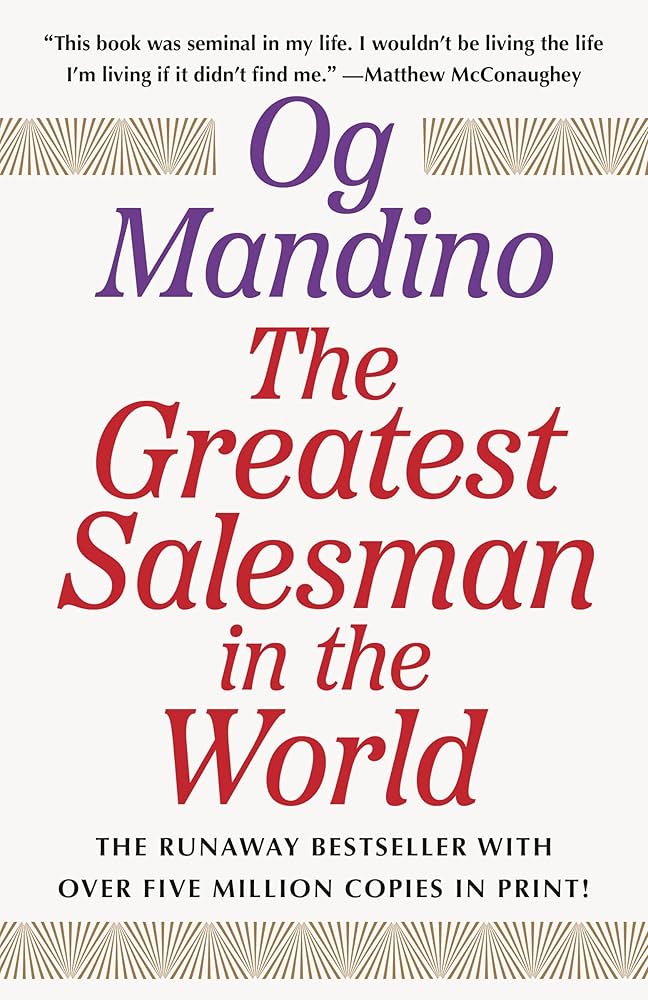
When I finally opened it, on some slow stretch of duty where there was nothing else to do, I found a fable rather than a manual. Mandino built the story around a camel boy named Hafid, who inherits ten scrolls from a dying mentor, each one a short set of instructions meant to be read aloud three times a day for thirty days before moving to the next. The scrolls have almost nothing to do with closing a sale. They are about replacing bad habits with good ones, greeting each day with intention instead of dread, and pushing past the point where most people quit. One of them says, in six words, “I will persist until I succeed.” To a soldier in the late nineties still figuring out what kind of man the uniform was supposed to make of him, that structure, repetition as the engine of change, landed close to what the Army itself was already trying to drill into me. I did not read it for inspiration. I read it for instructions.
I have gone back to it more times than I can count since then, across three tours in Iraq and every rank I have held. It does not read the same book twice. The first time through, it worked like a set of orders for a kid who needed some. In my thirties, worn down by deployments and the ordinary grind of a career, the scroll on persistence read less like a command and more like a hand on the shoulder. Now, years into leading people instead of only myself, the scrolls about self-worth and about treating each day as though it might be the last read like a description of what I owe the soldiers and civilians under me.
The book itself is still on my shelf, and I’ve held not only because my mom gave it to me, but because the story is so good, the scrolls are so helpful. I highly recommend you read this as the book describes, submit yourself to its practice. Once you have I’d love to hear your feelings, your thoughts, your outcome.