This is the 40th Anniversary of AI… Would you believe we’re at Four Decades already? A DoD and Army Timeline.
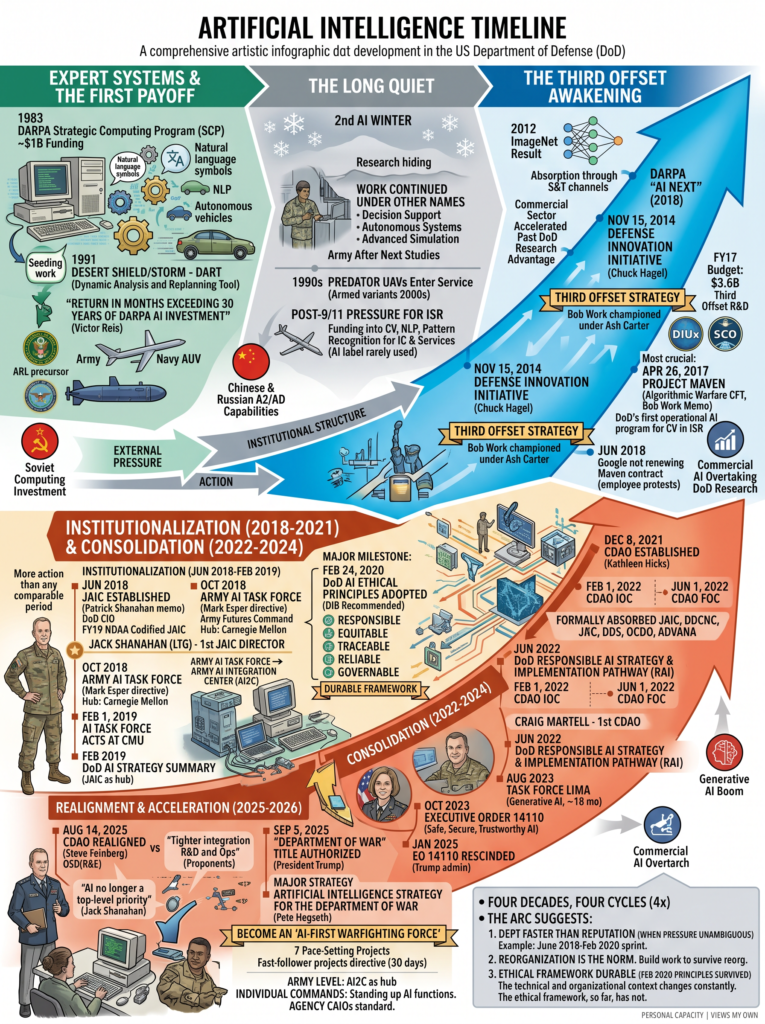
The Department of Defense has been working with artificial intelligence for longer than most people outside the building realize. The current push under Secretary Hegseth’s January 2026 AI Acceleration Strategy is the newest chapter, not the first.1 The arc runs back more than forty years, and the pattern it traces is worth understanding on its own terms.
What the timeline shows is a cycle. External pressure produces action. Action produces institutional structure. New leadership reorganizes the structure. Then a new external pressure arrives and the cycle repeats. Understanding where DoD and the Army are now requires understanding how the cycle has run four times already.
Expert Systems and the First Payoff (mid-1980s to early 1990s)
The Department’s first serious institutional bet on AI came through the Strategic Computing Program, launched by DARPA in 1983 with congressional appropriations that would total roughly one billion dollars over the decade.2 The program was explicitly targeted at DoD applications rather than pure research, and it seeded work on expert systems, natural language processing, autonomous vehicles, and the hardware needed to support all of it. Army participation was significant, particularly through Army Research Laboratory precursor organizations and the service’s growing interest in decision aids for command and control.
The payoff came in 1991. The Dynamic Analysis and Replanning Tool, known as DART, was an expert system used to plan the movement of personnel, equipment, and supplies during Operations Desert Shield and Desert Storm.3 Victor Reis, then Director of DARPA, stated that DART returned in a matter of months more than the total DARPA investment in AI research over the preceding thirty years.4 That specific accounting has entered the institutional folklore of defense AI, and the underlying claim that DART produced operationally meaningful savings is well documented.
That period also saw the Army invest in expert systems for maintenance diagnostics, mission planning, and signal analysis, and it saw the Navy field early autonomous underwater systems. AI in DoD was quiet, applied, and mostly focused on decision support.
The Long Quiet (mid-1990s to mid-2000s)
The second AI winter hit hard. Commercial expert system companies collapsed. Academic funding contracted. Inside the Department, AI as a labeled activity largely disappeared from budget documents and strategy language.
The work did not stop. It went by other names. “Decision support systems,” “autonomous systems,” “advanced simulation,” and “intelligent tutoring” continued to receive investment through the services and DARPA. The Army After Next studies of the late 1990s explored the implications of information-age warfare for force design, and unmanned aerial systems research at the Army Research Laboratory and the Air Force Research Laboratory continued to advance the autonomy stack. Predator UAVs entered service in the 1990s, and armed variants followed in the early 2000s.
The nine-eleven attacks and the wars that followed produced enormous pressure for intelligence, surveillance, and reconnaissance capability. That pressure funded computer vision, natural language processing, and pattern recognition work across the intelligence community and the services, though the acronym AI was rarely used to describe it. By the mid-2000s, the technical foundations for the next wave were being laid inside DoD even as the label itself remained out of favor.
The Renaissance Arrives Quietly (mid-2000s to 2013)
The deep learning breakthrough that made 2012 a watershed year in commercial AI took several years to register inside DoD. The 2012 ImageNet result demonstrated that convolutional neural networks could dramatically outperform prior computer vision techniques, and the implications for ISR were obvious to anyone paying attention.5
DoD absorbed the renaissance through science and technology channels rather than through headline strategy. DARPA continued to fund the AI portfolio that would become foundational for later applications and would formally launch its “AI Next” campaign in 2018.6 The Army Research Laboratory expanded its machine learning portfolio. Service laboratories built teams that could operationalize commercial advances. None of this generated the kind of top-line strategic attention that later work would receive.
By 2013 and 2014, senior leaders inside OSD were beginning to notice that the commercial sector had accelerated past the Department’s traditional research advantage in ways that had never happened before. That recognition set up the next phase.
The Third Offset Awakening (November 2014 to 2017)
On November 15, 2014, Secretary of Defense Chuck Hagel announced the Defense Innovation Initiative at the Reagan National Defense Forum.7 Hagel’s speech identified robotics, autonomous systems, miniaturization, big data, and advanced manufacturing as the technology areas the Department would prioritize to sustain what he described as America’s military edge. The framing came to be known as the Third Offset Strategy, positioned as a successor to the nuclear offset of the 1950s and the precision-strike offset that Harold Brown and William Perry drove in the 1970s.
Deputy Secretary of Defense Bob Work became the Third Offset’s operational champion. Under Ash Carter as Secretary, the fiscal year 2017 budget included approximately three point six billion dollars in Third Offset research and development funding, and the initiative produced organizational innovations including the Defense Innovation Unit Experimental in Silicon Valley and the Strategic Capabilities Office.8
The most consequential AI-specific action of this period was Deputy Secretary Work’s April 26, 2017, memorandum establishing the Algorithmic Warfare Cross-Functional Team, better known as Project Maven.9 Maven was DoD’s first operational AI program, aimed at applying computer vision to full-motion video from ISR platforms. It also became the first program to face significant public controversy over defense AI, when Google announced in June 2018 that it would not renew its Maven contract following employee protests.10
Institutionalization (2018 to 2021)
The fifteen months between mid-2018 and early 2019 saw more institutional AI action inside DoD than any comparable period before or since.
In June 2018, Deputy Secretary of Defense Patrick Shanahan signed the memorandum establishing the Joint Artificial Intelligence Center, known as JAIC, under the DoD Chief Information Officer.11 The FY19 National Defense Authorization Act codified the JAIC’s role and directed it to coordinate DoD AI projects exceeding fifteen million dollars per year.12 Air Force Lieutenant General Jack Shanahan (no relation to the Deputy Secretary), who had led Project Maven, became the JAIC’s first director.
In October 2018, Secretary of the Army Mark Esper signed the directive establishing the Army Artificial Intelligence Task Force under Army Futures Command, which had itself only been activated the previous August.13 Carnegie Mellon University was selected as the hub, and the Task Force formally activated at CMU’s National Robotics Engineering Center on February 1, 2019, under Brigadier General Matt Easley.14
Also in February 2019, the Department released its Summary of the 2018 Department of Defense Artificial Intelligence Strategy, the first public DoD-wide AI strategy.15 The document laid out a framework for accelerating AI adoption across the Joint Force and named the JAIC as the coordinating hub.
A year later, on February 24, 2020, the Department formally adopted the five ethical principles for AI recommended by the Defense Innovation Board: Responsible, Equitable, Traceable, Reliable, and Governable.16 These principles remain the ethical framework for DoD AI work today.
In October 2020, the Army Artificial Intelligence Task Force was renamed the Army Artificial Intelligence Integration Center, known as AI2C, retaining its Carnegie Mellon partnership while shifting into a more permanent institutional structure.17
Deputy Secretary of Defense Kathleen Hicks issued the implementing memorandum on Responsible Artificial Intelligence in May 2021, formally directing the Department to operationalize the five principles across acquisition, development, and deployment.18
Consolidation (2022 to 2024)
The consolidation phase reorganized what the institutionalization phase had built. Deputy Secretary Hicks directed the establishment of the Chief Digital and Artificial Intelligence Officer on December 8, 2021, and the office reached initial operating capability on February 1, 2022.19 On June 1, 2022, the CDAO reached full operating capability and formally absorbed the JAIC, the Defense Digital Service, the Office of the Chief Data Officer, and the Advana program.20 Craig Martell became the first CDAO. The office reported directly to the Deputy Secretary of Defense, a reporting relationship that was widely interpreted as a signal of elevated priority.
In June 2022, the CDAO released the DoD Responsible AI Strategy and Implementation Pathway, which remains the Department’s foundational RAI governance document.21
The August 2023 establishment of Task Force Lima, chartered to accelerate DoD’s understanding and adoption of generative AI, marked the Department’s first structured response to the ChatGPT era.22 Task Force Lima ran for approximately eighteen months and produced findings that informed the CDAO’s generative AI approach.
The Biden administration’s Executive Order 14110 on the Safe, Secure, and Trustworthy Development and Use of Artificial Intelligence, issued in October 2023, established the broader federal AI governance architecture that DoD implemented through internal policy.23 Executive Order 14110 was subsequently rescinded by the Trump administration in January 2025.24
Realignment and Acceleration (2025 to 2026)
The current phase began with a series of reorganizations. On August 14, 2025, Deputy Secretary of Defense Steve Feinberg realigned the CDAO under the Under Secretary of Defense for Research and Engineering, ending the direct report to the Deputy Secretary that had been established in 2021.25 Retired Lieutenant General Jack Shanahan, the original JAIC director, publicly characterized the move as a signal that AI was no longer a top-level priority.26 Proponents argued that the realignment would produce tighter integration between AI research and operational deployment.
On September 5, 2025, President Trump signed an executive order authorizing “Department of War” as a secondary title for the Department of Defense in correspondence and non-statutory documents.27 A formal legal renaming would require congressional action.
On January 9, 2026, Secretary Pete Hegseth issued the Artificial Intelligence Strategy for the Department of War along with two companion memoranda.28 The strategy directs the Department to become an “AI-first warfighting force” and identifies seven Pace-Setting Projects to anchor near-term acceleration. Each military department, combatant command, and defense agency was directed to identify at least three fast-follower projects within thirty days.
At the Army level, AI2C continues to serve as the service’s AI integration hub. Individual commands, agencies, and program executive offices are standing up their own AI functions, and Chief AI Officer designations at agency level are becoming standard.
What the Arc Suggests
Four cycles in forty years. Each cycle followed the same rough shape: external pressure produced action, action produced institutional structure, new leadership reorganized the structure, and then a new external pressure arrived. The Strategic Computing Program was a response to Soviet computing investment. The Third Offset was a response to Chinese and Russian A2/AD capabilities. Institutionalization in 2018 was a response to commercial AI overtaking DoD research. The current acceleration phase is a response to the generative AI boom and the competitive pressure it produces.
Three observations that follow from the pattern:
The Department is faster than its reputation suggests when the pressure is unambiguous. The fifteen-month sprint from June 2018 to February 2020 produced a coordinating office, a service task force, a public strategy, and a formal ethics framework. That is a fast institutional cadence by any measure.
Reorganization is the norm, not the exception. Every administration since 2014 has restructured the DoD AI enterprise. Practitioners inside the building learn to build their work in ways that survive reorganization, because reorganization always comes.
The ethical framework has been durable across administrations. The five principles adopted in February 2020 have survived the Biden administration, the Trump administration, EO 14110’s issuance and rescission, the CDAO’s elevation and demotion, and the shift to an AI-first posture. That durability is worth noting. The technical and organizational context changes constantly. The ethical framework, so far, has not.
The next chapter is being written now. Understanding the four that came before will help everyone involved write it more clearly.
Written in personal capacity with the assistance of AI. The views expressed are my own and do not represent the Department of the Army, the Department of War, or any component thereof.
Notes
Carnegie Mellon University. “Carnegie Mellon Hosts Activation of U.S. Army AI Task Force.” News release, February 1, 2019.
Center for Strategic and Budgetary Assessments. Securing the Third Offset Strategy: Priorities for the Next US Secretary of Defense. Washington, DC: CSBA, 2016.
Conger, Kate, and Dell Cameron. “Google Is Helping the Pentagon Build AI for Drones.” Gizmodo, March 6, 2018.
Defense Advanced Research Projects Agency. “DARPA Announces $2 Billion Campaign to Develop Next Wave of AI Technologies.” News release, September 7, 2018.
Defense Innovation Board. AI Principles: Recommendations on the Ethical Use of Artificial Intelligence by the Department of Defense. Washington, DC: Department of Defense, October 31, 2019.
DoD Responsible AI Working Council. U.S. Department of Defense Responsible Artificial Intelligence Strategy and Implementation Pathway. Washington, DC: Office of the Chief Digital and Artificial Intelligence Officer, June 2022.
Executive Order No. 14110. “Safe, Secure, and Trustworthy Development and Use of Artificial Intelligence.” 88 Fed. Reg. 75191, November 1, 2023.
Feinberg, Steve. Deputy Secretary of Defense. Memorandum realigning the Chief Digital and Artificial Intelligence Officer to the Under Secretary of Defense for Research and Engineering. August 14, 2025.
Flaherty, Anne, and Selina Wang. “Trump Signs Order Renaming Pentagon ‘Department of War.'” ABC News, September 5, 2025.
Fouse, Scott, Stephen Cross, and Zachary J. Lapin. “DARPA’s Impact on Artificial Intelligence.” AI Magazine 41, no. 2 (Summer 2020): 3–8.
Hagel, Chuck. “Reagan National Defense Forum Keynote.” Remarks, Ronald Reagan Presidential Library, Simi Valley, CA, November 15, 2014.
Hedberg, Sara Reese. “DART: Revolutionizing Logistics Planning.” IEEE Intelligent Systems 17, no. 3 (May–June 2002): 81–83.
Hegseth, Pete. Secretary of Defense. “Artificial Intelligence Strategy for the Department of War.” Memorandum, January 9, 2026.
Hicks, Kathleen H. Deputy Secretary of Defense. “Establishment of the Chief Digital and Artificial Intelligence Officer.” Memorandum, December 8, 2021.
Hicks, Kathleen H. Deputy Secretary of Defense. “Establishment of the Chief Digital and Artificial Intelligence Officer Generative Artificial Intelligence and Large Language Models Task Force, Task Force Lima.” Memorandum, August 10, 2023.
Hicks, Kathleen H. Deputy Secretary of Defense. “Implementing Responsible Artificial Intelligence in the Department of Defense.” Memorandum, May 26, 2021.
Holland & Knight. “Department of War’s Artificial Intelligence-First Agenda: A New Era for Defense Contractors.” Client alert, February 2026.
John S. McCain National Defense Authorization Act for Fiscal Year 2019. Public Law No. 115-232, § 238, 132 Stat. 1636 (2018).
Keck, Zachary. “A Tale of Two Offset Strategies.” The Diplomat, November 18, 2014.
Krizhevsky, Alex, Ilya Sutskever, and Geoffrey E. Hinton. “ImageNet Classification with Deep Convolutional Neural Networks.” In Advances in Neural Information Processing Systems 25, edited by F. Pereira, C. J. C. Burges, L. Bottou, and K. Q. Weinberger, 1097–1105. Red Hook, NY: Curran Associates, 2012.
Park, Nicholas. “Army’s Pittsburgh-Based Center Accelerates Development of AI Applications.” Army News Service, October 12, 2021.
Reichmann, Kelsey. “DOD’s AI Acceleration Strategy.” Nextgov/FCW, February 2, 2026.
Roland, Alex, with Philip Shiman. Strategic Computing: DARPA and the Quest for Machine Intelligence, 1983–1993. Cambridge, MA: MIT Press, 2002.
Sayler, Kelley M. Realignment of DOD’s Chief Digital and AI Officer (CDAO). CRS Report IN12615. Washington, DC: Congressional Research Service, September 30, 2025.
Shanahan, Patrick M. Deputy Secretary of Defense. “Establishment of the Joint Artificial Intelligence Center.” Memorandum, June 27, 2018.
Tadjdeh, Yasmin. “Algorithmic Warfare: Army’s AI Task Force Making Strides.” National Defense Magazine, October 8, 2019.
Tadjdeh, Yasmin. “Army Solicitating Wide Array of AI Technologies.” National Defense Magazine, October 12, 2021.
U.S. Department of Defense. “DOD Adopts Ethical Principles for Artificial Intelligence.” News release, February 24, 2020.
U.S. Department of Defense. Summary of the 2018 Department of Defense Artificial Intelligence Strategy: Harnessing AI to Advance Our Security and Prosperity. Washington, DC: Department of Defense, February 12, 2019.
Vincent, Brandi. “2022 in Review: What the Pentagon’s CDAO Accomplished in Its Inaugural Year.” DefenseScoop, December 30, 2022.
Wakabayashi, Daisuke, and Scott Shane. “Google Will Not Renew Pentagon Contract That Upset Employees.” New York Times, June 1, 2018.
The White House. “Removing Barriers to American Leadership in Artificial Intelligence.” Executive Order, January 23, 2025.
Work, Robert O. Deputy Secretary of Defense. “Establishment of an Algorithmic Warfare Cross-Functional Team (Project Maven).” Memorandum, April 26, 2017.